
AQUA-HOP technology
The Hybrid Oxidation Process
A physicochemical treatment train that combines electrochemistry, physical filtration and advanced oxidation, without relying on a living biological culture.
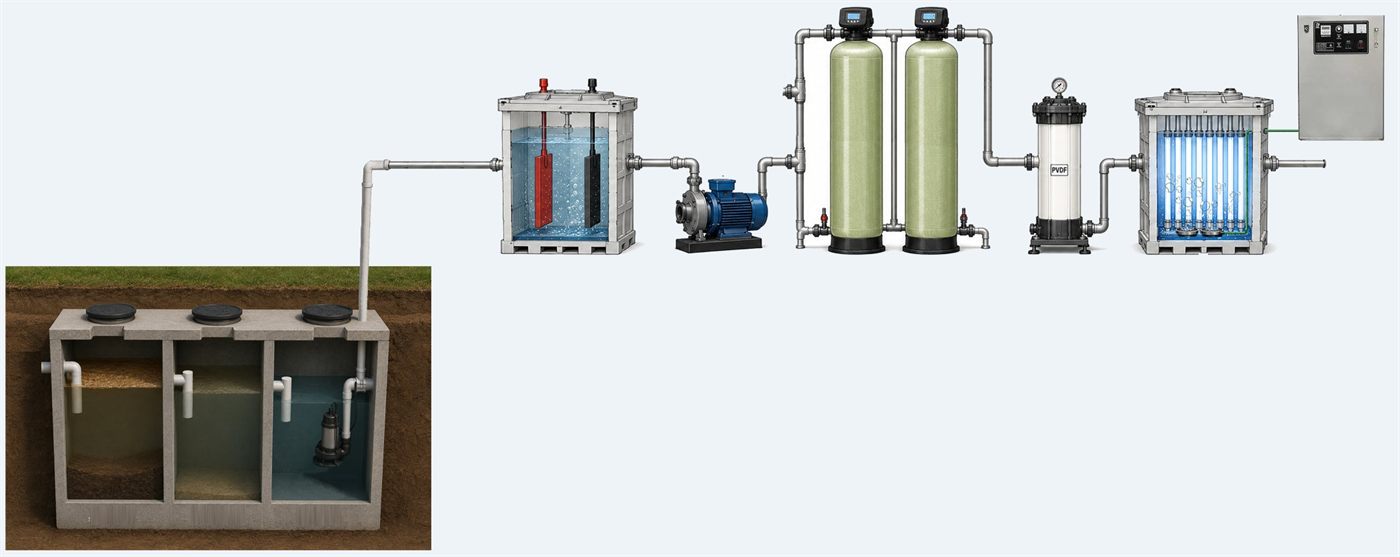
Solids settle out across three chambers; a submersible pump lifts the clarified water.
An electric current releases coagulants from the electrodes; flocs float up and are removed.
A centrifugal pump moves the water on to the filtration stage.
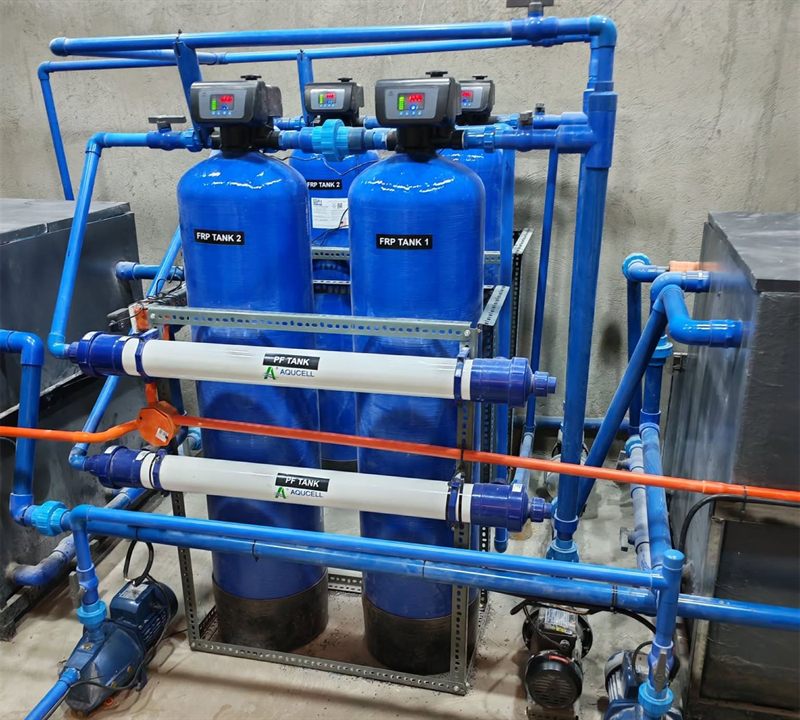
Twin FRP tanks of sand, activated carbon and gravel, with automatic backwash.
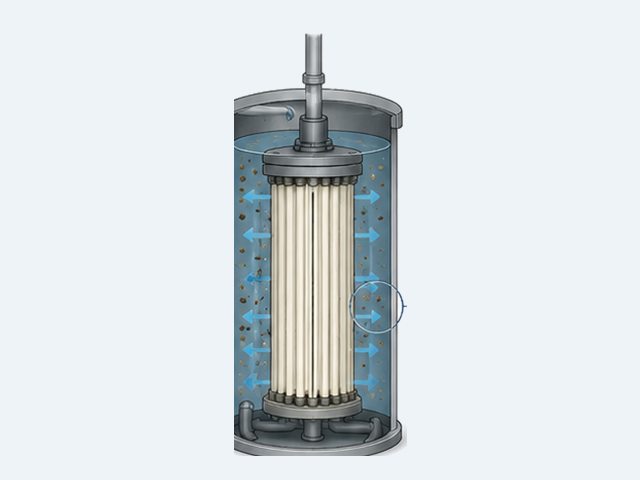
PVDF hollow-fibre membranes hold back fine particles and bacteria.
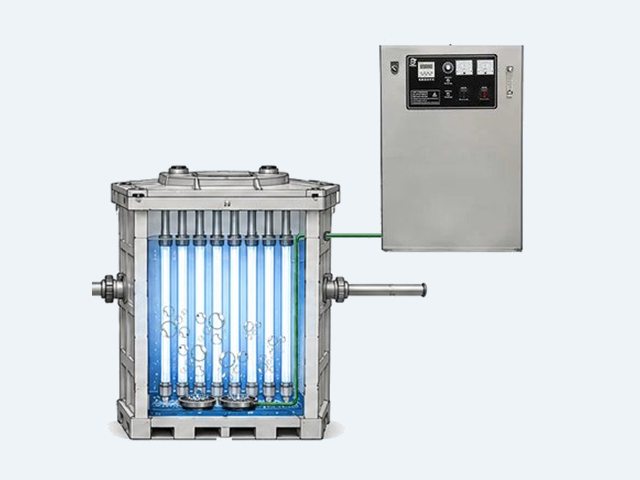
UVC lamps and ozone generate hydroxyl radicals that oxidise and disinfect.
Treated effluent leaves the system for discharge.
Stage by stage
Inside each treatment stage
Select a stage to see what happens to the water and which parameters it addresses.
Settling chambers
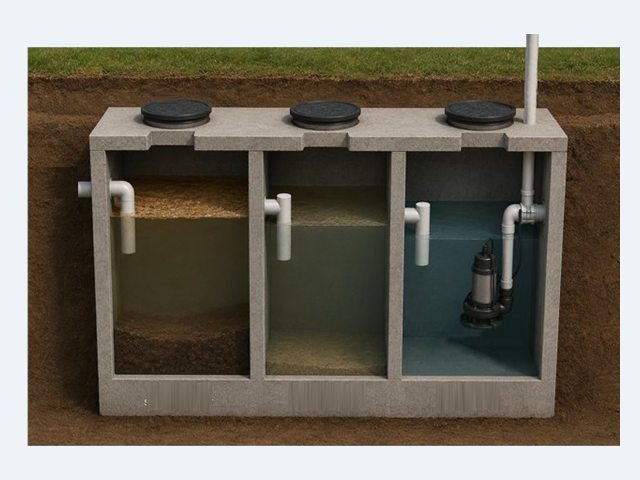
Raw wastewater enters a multi-chamber tank. Heavier solids settle, the liquid clarifies as it passes from chamber to chamber, and a submersible pump in the last chamber sends it on to treatment.
- Wastewater enters the first chamber
- Heavier solids settle to the bottom
- Clarified liquid flows on to the next chamber
- A submersible pump transfers it to the treatment train
Electrocoagulation
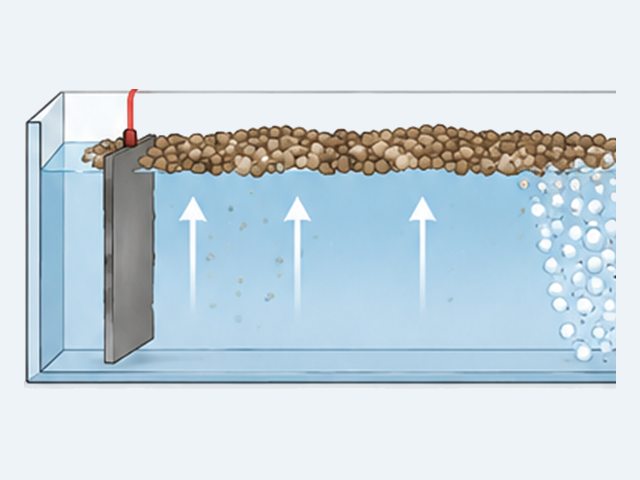
A DC power supply is connected to sacrificial metal electrodes, typically aluminium or iron, inside a modular electrochemical tank. The metal ions they release form coagulants directly in the water.
- Current passes between the anode and the cathode
- The anode releases metal ions (Al³⁺ or Fe²⁺/Fe³⁺)
- The ions form metal hydroxide coagulants
- Coagulants neutralise the charge on colloids and emulsified oil
- Particles clump into flocs; hydrogen bubbles from the cathode float them up
- Floated flocs are removed and the clarified water moves on
Media filtration
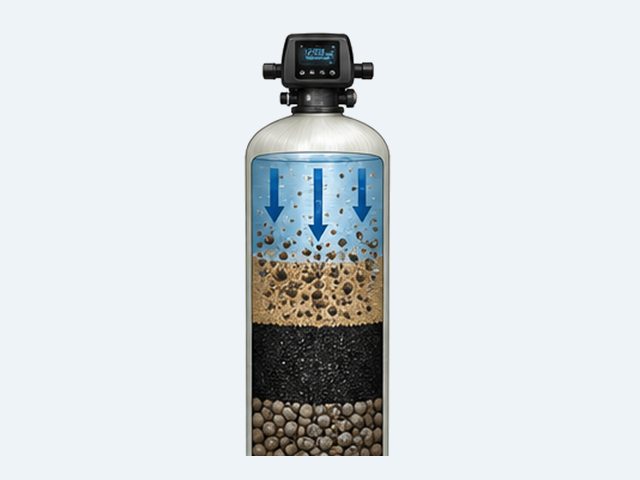
A centrifugal pump transfers the water to twin fibre-reinforced plastic (FRP) tanks. Each holds layered media and a digital control head that runs the backwash cycle automatically.
- Water enters the top of the tank through the control valve
- Silica sand (0.4–0.8 mm) traps fine suspended particles
- Granular activated carbon (0.8–2.0 mm) adsorbs colour, odour and organic compounds
- Graded pebbles (8–16 mm) support the media and spread the flow
- Filtered water rises through the centre pipe and exits
- When the media loads up, the control head backwashes it automatically
Ultrafiltration
Water is pushed through PVDF hollow-fibre membranes with pores of roughly 0.01–0.1 µm. Clean water passes into the fibres; particles and bacteria are held on the outside. PVDF is chemically resistant and mechanically strong.
- Water surrounds the hollow-fibre membranes
- Pressure drives it through the microscopic pores
- Clean permeate collects inside the fibres
- Retained solids are kept in check by scouring or crossflow
- Concentrate is discharged from the housing
UV + ozone
In the final modular tank, an array of UVC lamps (254 nm) and ozone from an ozone generator work together. UV light converts ozone and water into hydroxyl radicals, which oxidise compounds that conventional treatment leaves behind and disinfect the water.
- Ozone is generated from oxygen and introduced through fine-bubble diffusers
- Dissolved ozone oxidises contaminants directly
- UVC light (254 nm) turns ozone and water into hydroxyl radicals
- Hydroxyl radicals break down refractory organics, colour and odour compounds
- Treated effluent is discharged
Parameter map
Which stage handles what
How the treatment train addresses key parameters in the DENR General Effluent Standards (DAO 2016-08, as amended by DAO 2021-19).
| Parameter | Primary treatment stage | Mechanism |
|---|---|---|
| BOD / COD | Electrocoagulation and UV + ozone | Flocculation and chemical oxidation |
| Fecal coliform | Ultrafiltration and UV + ozone | Physical barrier and disinfection |
| TSS | Electrocoagulation and sand filtration | Precipitation and mechanical filtration |
| Phosphate | Electrocoagulation | Chemical precipitation |
| Surfactants | Activated carbon and electrocoagulation | Adsorption and charge neutralisation |
| Oil & grease | Electrocoagulation | Electro-flotation |
| Ammonia / nitrate | Ozone | Chemical oxidation |
| pH | Electrocoagulation, then final adjustment | Electrolysis can shift pH; buffering may be needed |
This shows the mechanism each stage relies on, not guaranteed results. Actual effluent quality depends on the incoming wastewater, flow rate and system design, and is confirmed by laboratory analysis.
Comparison
HOP compared with biological systems
Biological systems rely on living bacteria to digest waste. HOP uses electricity, physical barriers and chemical reactions, which changes how it behaves from day to day.
| Consideration | Biological (SBR, MBBR, MBR) | Hybrid Oxidation Process |
|---|---|---|
| Start-up | Days to weeks to establish biomass | Operates once commissioned |
| Load and toxic shocks | Biomass can be lost; recovery takes time | No living culture to lose |
| Intermittent operation | Needs a steady feed to stay healthy | Can be switched on and off |
| Sludge | Higher volume of biological sludge | Smaller volume of compact chemical sludge |
| Disinfection | Usually a separate chlorination step | Built in through UF, UVC and ozone |
| Footprint | Large tanks for biological contact time | Compact, modular tanks |
| Routine maintenance | Biological monitoring, dissolved-oxygen control | Electrode replacement, membrane cleaning |
A general, qualitative comparison. Actual performance depends on wastewater characteristics, flow rate and system design, and is confirmed through effluent laboratory analysis.
Contact
Is HOP right for your facility?
Start here. It takes about a minute.
Let's understand your facility, your wastewater and your treatment requirements.
- 01Tell us about your facility and the problem you're seeing.
- 02We review the details and follow up to understand your wastewater and requirements.
- 03We recommend a practical way forward: assessment, design, upgrade or servicing.
- Phone
- +63 997 904 3399
- Office
- Brgy. Talaga, Capas, Tarlac
visits to the AQUA-HOP website